The Maze by Steven Monte
The hero finds himself within the maze:
the minotaur awaits him. He’s pulled strings
to get this far. And since he has no wings,
he must stay grounded, thinking of the ways
to make sure, even down the paths he strays
(all the wrong turns and false imaginings),
he’s moving forward in the scheme of things—
which, at the moment, means he sits. He prays
as if to coax the wind or tide to turn
more in his favor. All of his concern
is focused on minutiae. Weeks and days
will pass before the time is opportune.
That time has now arrived. He hums a tune.
A form emerges from the mist and haze.
A form emerges from the mist and haze.
Human or monster? friend or enemy?
Fate, then? No, something fated to amaze:
he sees, or thinks he sees, his heart, turned tree—
knotted and gnarled—whose leaves form a crown;
its branches thrash like waves in open sea.
The wind is rising; sun is going down.
He must approach the tree to start the story.
Perhaps he is no hero, just a clown?
One small step from embarrassment or glory,
he peers into his heart, resolved to mull
the consequences of his allegory.
But much of what will follow will be dull:
after the first encounter, there’s a lull.
After the first encounter, there’s a lull
for backstory, pacing, comic relief.
It’s here that storytellers need to cull
from ancient tales, to garner new belief.
Let them present us with a heroine
who’s independent. Let her simply be—
or save herself from any scrape she’s in
with brains and guts (metaphorically).
Stirring and shaking, let them mix a drink
that’s strong and smooth; let there be chemistry
between the lovers, fun that makes us think,
developments that we could not foresee
and yet feel right . . .
The story can be flipped.
But, really, how much can we go off script?
But how much, really, can we go off script?
is an eternal question. Now it hangs
over our hero, who prepares, tight-lipped,
for monsters in his heart to show their fangs.
He would reject all talk of the heroic,
even when waging war for his own soul.
Yet somehow here he is, playing the stoic,
gritting his teeth, falling into a role . . .
“We are merely players” never consoles
someone who’s searching for integrity.
Even the thought we are our habits/goals
doesn’t sit well. He stares into the tree.
Belief that he’s a fiction can’t annul
heart-pounding in the chest, brain in the skull.
Heart pounding in the chest, brain in the skull,
he steps into the tree, his heart, the maze.
The time has come for action: end the lull.
And whether he’s fulfilling roles he plays
or just reacting to the moment he is in,
he seizes the moment, setting out to blaze
a path suggested by the heroine
threading an underground way through his heart.
If he is playing, he’s playing to win.
He knows what he must do now: tear apart
himself, and learn to live with what he’s ripped—
more art than science, and more knack than art.
At times like this, forget about the script.
For striving, at least, we seem well-equipped.
For striving, at least, we seem, well, equipped
for some events much more than others. We
are born, in many ways, for poetry:
children love wordplay; rhyme is sweet when sipped.
Then something happens. Poems seem a crypt
scarier than a nightmare. We can’t see
an exit from a maze now seemingly
unsolvable, a trap that has been tripped.
But every indirection is a plea
for your attention, if not for your love.
When the path forks, instead of thinking of
a monster, revel in the mystery:
a world where heroes wear a jester’s crown,
a world already turning upside-down.
A world already turning upside-down
feels like it’s marching into latter days.
The hero senses this, knowing the maze
generates ways for him to gain renown
and prove himself: to feel some end is near.
Desire makes the minotaur appear.
And facing his ambitions and his aims,
he sees their ugliness, almost despairs
of all the things for which he deeply cares
(love, song, and laughter) now reduced to games
of conquest. Tenderness goes up in flames.
The minotaur roars, showing teeth, and glares
into and at us with the truth it bares:
the heart is filled with feelings no one tames.
The heart is filled with feelings no one tames,
characters, stories making up our “self”
(our aspirations, and our guilts and shames),
but we aren’t books left lying on a shelf.
We’re what we’re doing: now, and now, and now.
To be a hero is to be a kind of fool.
And, given ugliness, we must allow
that minotaur-truth is always half-bull.
Enough of riddles. Lines have now been crossed
between a myth and time when I was lost.
We were lost, rather . . .
The sign “Au Labyrinthe”
promises a hedge-maze. Paths lead us down
a hill. We strain to see the maze, but can’t—
a field of shrubs turned desiccated-brown.
A field of shrubs turned desiccated-brown:
we take a moment to take in the scene.
Where did we go wrong, then? I smile. You frown.
Surely these twigs aren’t “the maze of the queen”?
Or were they? hedges that had gone to ground
whose twists and turns dissolved into the air?
They were the labyrinth we never found
and one we entered into unaware.
I find myself again immersed in myth.
We didn’t find the maze. That much is true.
And we broke up, as this poem proclaims
in tacit ways. My verse is toying with
fiction and facts, attempting to see through
and beyond memory, beyond all games.
And beyond memory, beyond all games,
is what? More games and more memories.
A park in New York City. Autumn trees.
Post-breakup scene, with branches bright as flames.
We’re in a group, yet separate somehow.
Some jerk approaches. Hits on you. I say
“Leave her alone!” He wavers, skulks away.
A feeling, like love, overcomes us now.
It was a moment. A hero-playing role.
We both felt it instinctively: at last
the script had caught us, when our chance had passed.
Yet we, who were “just us,” weren’t in control
of what we felt—not there, and now not here.
Life whispered something baffling yet clear.
Life whispered something baffling yet clear:
the tales we tell of hero-heroine
speak to ourselves, and what we hope and fear—
the net we cast, and the net we are in.
So is this poem merely skirting round
memories and ideas? life and its mess?
Yes and surely no. Heroism’s bound
to stake a claim to progress, more or less.
And here we are, lost in another maze
yet moving forward. I think of all the days
after the breakup: I wanted to go back
and manage something more (or just instead)
of what I did, and parry your “attack”:
What is there to say? What hasn’t been said?
What is there to say? What hasn’t been said?
All songs are “nothing new beneath the sun.”
And yet some words are called for. I have read
of lovers swearing that they were most one
when least expecting it: after a break.
Perhaps. But it takes nothing from the pain,
and nothing from the longing or the ache
for a renewal, and stating things plain.
Much must stay obscure, though. Call it a law
or love or loving. Whatever you saw
(“you” meaning me) and struggled to work through
in the queen’s maze, had nonetheless come clear:
that break was final; this song ends with you
returning to the feelings that you fear.
Returning to the feelings that you fear,
you have an intimation you will meet
many years later, and now you are here.
Anticlimactically, you take a seat
across from her. Pink blossoms on a bough.
Eternal spring: your heart still skips a beat
albeit in new ways. You can’t say how.
A conversation. Laughter but no sighs.
So much had been intense. Where was that now?
Hero and heroine had both been wise
and foolish, leaving many things unsaid—
the hedges of the maze cut down to size.
We’ve reached the end to which this song has led.
Gather the strands. You can rewind the thread.
Gather the strands you can. Rewind the thread,
returning to the feelings that you fear.
What is there to say? What hasn’t been said?
Life whispered something, baffling yet clear
and beyond memory, beyond all games:
a field of shrubs turned desiccated-brown.
The heart is filled with feelings no one tames:
a world already turning upside-down.
For striving, at least, we seem well-equipped—
heart pounding in the chest, brain in the skull—
but how much can we really go off script?
After the first encounter, there’s a lull.
A form emerges from the mist and haze.
The hero finds himself within the maze.
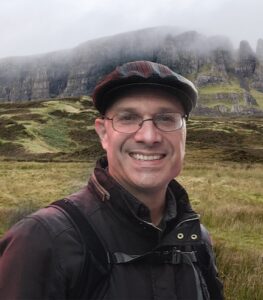
Steven Monte is a poet, verse translator, and English professor, who teaches at CUNY and lives in New York City. His translations range from Petrarch and Ariosto to Joachim Du Bellay and Victor Hugo. His current scholarship focuses on Renaissance poetry, including his book The Secret Architecture of Shakespeare’s Sonnets. He is an avid runner and hiker, and he believes that he has discovered where William Wordsworth took his wrong turn in the Alps.
Praise for the winning sonnet crown: “The Maze” is a stunning example of a heroic sonnet crown—so many things stood out for me. First, I admired the deft twining of the story and the circuitous form—the Minotaur’s maze winds into the speaker’s own twisting story of romance, break-up, and reunion. The poem interweaves musings on heroism, plot, fiction, poetry, and the reality of any given moment, adding depth and lyricism without losing sight of the narrative. The mastery of the sonnet form is evident throughout, with finely crafted meter and rhyme and a meaningful turn in each section. The final sonnet ends on the image of the hero from the beginning of the poem while imbuing it with haunting new meaning.
~ Midge Goldberg, Judge